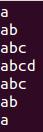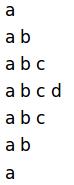
Solution:
For printing above output, first divide it into two parts. i.e
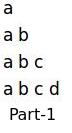
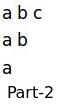
We can print above pattern in two ways. We can either use ASCII value or do it directly using character.
1. Using ASCII value
#include<stdio.h>
int main()
{
int i,j;
for(i=97;i<=100;i++) // This loop prints part-1 using ASCII value
{
for(j=97;j<=i;j++)
{
printf("%c",j);
}
printf("\n");
}
for(i=99;i>=97;i--) // This loop prints part-2 using ASCII value
{
for(j=97;j<=i;j++)
{
printf("%c",j);
}
printf("\n");
}
return 0;
}
2. Directly using character value
#include<stdio.h>
int main()
{
char i,j; // Here, variable i and j are defined as character type.
for(i='a';i<='d';i++) // This loop print part-1 using character value
{
for(j='a';j<=i;j++)
{
printf("%c",j);
}
printf("\n");
}
for(i='c';i>='a';i--) //This loop prints part-2 using character value
{
for(j='a';j<=i;j++)
{
printf("%c",j);
}
printf("\n");
}
return 0;
}
Output: