Introduction to Database Transaction
- Database Transaction is an atomic unit that contains one or more SQL statements.
- It is a series of operations that performs as a single unit of work against a database.
- It is a logical unit of work.
- It has a beginning and an end to specify its boundary.
- The above example defines a very simple and small transaction that tells how the transaction management actual works.
Let's take an simple example of bank transaction, Suppose a Bank clerk transfers Rs. 1000 from X's account to Y's account.
X's Account
open-account (X)
prev-balance = X.balance
curr-balance = prev-balance – 1000
X.balance = curr-balance
close-account (X)
Decreasing Rs. 1000 from X's account, saving new balance that is current balance and after completion of transaction the last step is closing the account.
Y's Account
open-account (Y)
prev - balance = Y.balance
curr - balance = prev-balance + 1000
Y.balance = curr-balance
close-account (Y)
Adding Rs. 1000 in the Y's account and saving new balance that is current balance and after completion of transaction the last step is closing the account.
Transaction Properties
Following are the Transaction Properties, referred to by an acronym ACID properties:1. Atomicity
2. Consistency
3. Isolation
4. Durability
- ACID properties are the most important concepts of database theory.
- A transaction is a small unit of program which contains several low level tasks.
- These properties guarantee that the database transactions are processed reliably.
- Atomicity defines that all operations of the transactions are either executed or none.
- Atomicity is also known as 'All or Nothing', it means that either perform the operations or not perform at all.
- It is maintained in the presence of deadlocks, CPU failures, disk failures, database and application software failures.
- It can be turned off at system level and session level.
- Consistency defines that after the transaction is finished, the database must remain in a consistent state.
- It preserves consistency of the database.
- If execution of transaction is successful, then the database remains in a consistent state. If the transaction fails, then the transaction will be rolled back and the database will be restored to a state consistent.
- Isolation defines that the transactions are securely and independently processed at the same time without interference.
- Isolation property does not ensure the order of transactions.
- The operations cannot access or see the data in an intermediate state during a transaction.
- Isolation is needed when there are concurrent transactions occurring at the same time.
- Durability states that after completion of transaction successfully, the changes are required for the database.
- Durability holds its latest updates even if the system fails or restarts.
- It has the ability to recover committed transaction updates even if the storage media fails.
Transaction States
- A transaction is a small unit of program which contains several low level tasks.
- It is an event which occurs on the database.
1. Active
2. Partially Committed
3. Failed
4. Aborted
5. Committed
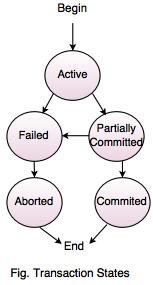
1. Active : Active is the initial state of every transaction. The transaction stays in Active state during execution.
2. Partially Committed : Partially committed state defines that the transaction has executed the final statement.
3. Failed : Failed state defines that the execution of the transaction can no longer proceed further.
4. Aborted : Aborted state defines that the transaction has rolled back and the database is being restored to the consistent state.
5. Committed : If the transaction has completed its execution successfully, then it is said to be committed.