Types of Relationship Mapping
Following are the types of Relationship Mapping,1. One - to - One Relationship
2. One - to - Many Relationship
3. Many - to - One Relationship
4. Many - to - Many Relationship
1. One - to - One Relationship
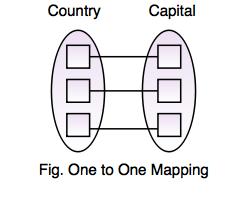
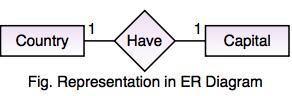
- In One - to - One Relationship, one entity is related with only one other entity.
- One row in a table is linked with only one row in another table and vice versa.
For example: A Country can have only one Capital City.
2. One - to - Many Relationship
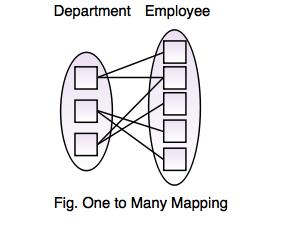
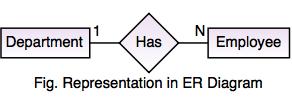
- In One - to - Many Relationship, one entity is related to many other entities.
- One row in a table A is linked to many rows in a table B, but one row in a table B is linked to only one row in table A.
For example: One Department has many Employees.
3. Many - to - One Relationship
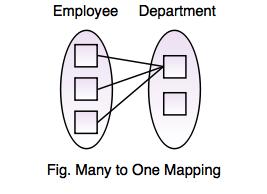
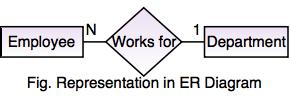
- In Many - to - One Relationship, many entities can be related with only one other entity.
For example: No. of Employee works for Department. - Multiple rows in Employee table is related with only one row in Department table.
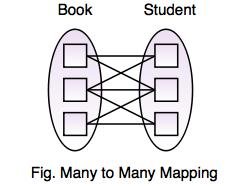
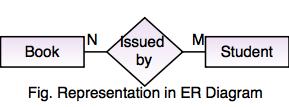
4. Many - to - Many Relationship
- In Many - to - Many Relationship, many entities are related with the multiple other entities.
- This relationship is a type of cardinality which refers the relation between two entities.
For example: Various Books in a Library are issued by many Students.
Participation Constraints
Following are the two types of Participation Constraints,1. Total Participation
2. Partial Participation
1. Total Participation
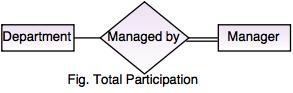
- In Total Participation, every entity in the set is involved in some association of the relationship.
- It is indicated by a double line (
 ) between entity and relationship.
For example: Every Department must have a Manager.
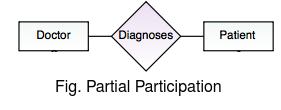
2. Partial Participation
- In Partial Participation, not all entities in the set are involved in association of the relationship.
- It is indicated by a single line (
 ) between entity and relationship.