Introduction to Query Processing
- Query Processing is a translation of high-level queries into low-level expression.
- It is a step wise process that can be used at the physical level of the file system, query optimization and actual execution of the query to get the result.
- It requires the basic concepts of relational algebra and file structure.
- It refers to the range of activities that are involved in extracting data from the database.
- It includes translation of queries in high-level database languages into expressions that can be implemented at the physical level of the file system.
- In query processing, we will actually understand how these queries are processed and how they are optimized.
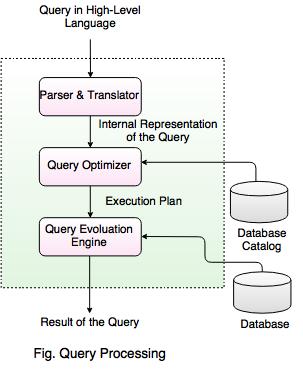
In the above diagram,
- The first step is to transform the query into a standard form.
- A query is translated into SQL and into a relational algebraic expression. During this process, Parser checks the syntax and verifies the relations and the attributes which are used in the query.
- The second step is Query Optimizer. In this, it transforms the query into equivalent expressions that are more efficient to execute.
- The third step is Query evaluation. It executes the above query execution plan and returns the result.
Translating SQL Queries into Relational Algebra
Example
SELECT Ename FROM Employee
WHERE Salary > 5000;
Translated into Relational Algebra Expression
σ Salary > 5000 (π Ename (Employee))
OR
π Ename (σ Salary > 5000 (Employee))

- A sequence of primitive operations that can be used to evaluate a query is a Query Execution Plan or Query Evaluation Plan.
- The above diagram indicates that the query execution engine takes a query execution plan and returns the answers to the query.
- Query Execution Plan minimizes the cost of query evaluation.