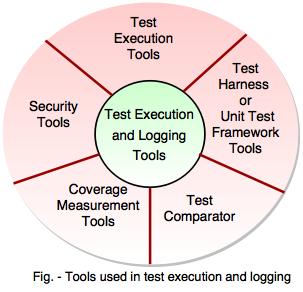
Following are the tools used for text execution and logging:
i) Test execution tools
ii) Test harness or Unit test framework tools
iii) Test comparator
iv) Coverage measurement tools
v) Security tools
i) Test execution tools
ii) Test harness or Unit test framework tools
iii) Test comparator
iv) Coverage measurement tools
v) Security tools
i) Test execution tools
- Test execution tools are called as test running tool as they help in running the tests efficiently.
- Test execution tools start with recording or capturing manual tests, hence they are called as capture or playback tools.
- These tools require a scripting language to run a particular tool. If any tester runs a test execution tool directly, he will require the programming skill to construct and modify the script because scripting language is a programming language.
- They record the test inputs during manual execution of tests.
- Expected output is stored in the form of the object and this output is compared with the next output.
- The tests are executed from the stored scripts.
- They run the test log results like pass or fail & provide the differences between expected and actual result.
- They compute the time for tests.
- Send the summary of outputs to the test management tool.
ii) Test harness / Unit test framework tools
- The test harness/ unit test framework tools are mostly used by the developers.
- Test harness provides stubs and drivers. Stubs and drivers are the small programs which interact with the software.
- Unit test framework tools are used in object-oriented software.
- The unit test framework is used in agile development to automate the tests along with the development.
- Both the tools i.e. harness and unit test framework allow the developers to test and recognize any defect.
- The stubs and drivers provide the required information and receive any information sent by the software.
- Provide the input to the software which is being tested.
- Receive the output produced by the tested software.
- Execute a set of tests in the framework.
- The pass or fail outputs are recorded for each test.
- Provide the support for debugging.
iii) Test comparator
- Test comparator help to automate the actual and expected results generated by the software.
- Dynamic comparison and post-execution comparison are the two ways in which actual result of test is compared with the expected result.
iv) Coverage measurement tools
- The coverage measurement tools are used to recognize the elements which can be counted.
- The process of recognizing the coverage items at component testing level is known as instrumenting the code.
- Recognize the coverage items.
- Calculate the percentage of coverage items tested by a set of tests.
- Report the coverage items which are not tested.
- Produce stubs and drivers if it is a part of a unit test framework.
v) Security tools
- Security testing tools are used to test the security of the system by hacking it.
- The attacks focus on the network, application code or database, provided software.
- Recognize the viruses and instructions.
- Simulate the different types of external attacks.
- Recognize the weaknesses in the password files and passwords.
- Security checks are completed during operations.